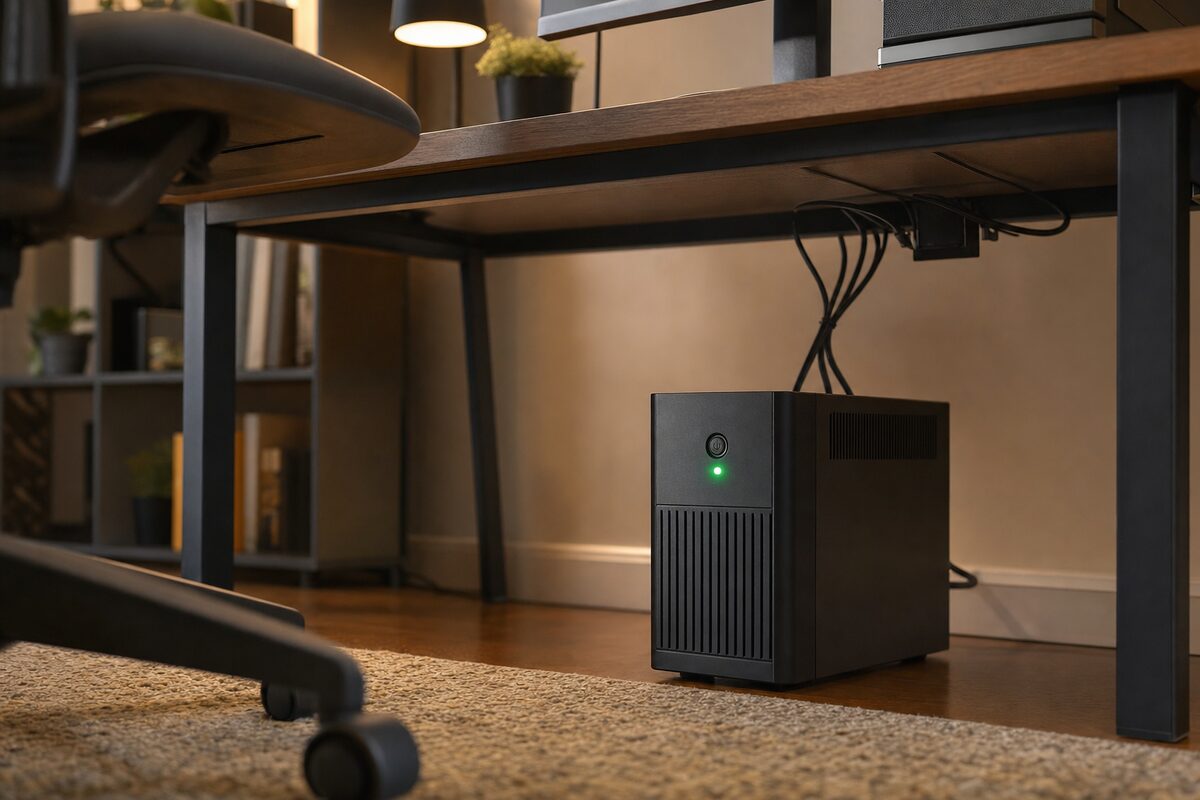
Power cuts are boring. That's actually the point.
When the lights flicker and the kettle dies, most people glance up, shrug, and carry on. But if you're sitting at a desktop PC or a plugged-in laptop, that same mundane moment can corrupt an open file, scramble a database, or — in a worst case — damage a hard drive mid-write. We see the results in the workshop more often than you'd think.
There's a small, quietly humming box that makes all of that somebody else's problem. It's called a UPS — an uninterruptible power supply — and it is, without question, one of the most sensible things a home or small-business computer user can buy. The question is which one, and whether you actually need one at all.
What a UPS Actually Does
A UPS sits between the wall socket and your equipment. Inside is a battery — usually sealed lead-acid — that charges constantly while the mains is live. The moment power drops, the battery cuts in so seamlessly that your computer never even notices. No restart, no lost work, no corrupted files.
Most home-grade UPS units give you somewhere between five and twenty minutes of runtime. That's not enough to keep working all afternoon — it's enough to save your document, close your applications, and shut down properly. Which is genuinely all you need.
They also filter out smaller electrical gremlins: voltage spikes, sags, and the brief brownouts that can stress components silently over months. Your computer probably won't tell you it's suffering — it'll just feel a bit unreliable and die earlier than it should.
Who Actually Needs One?
Not everyone. If you use a laptop on battery for most of the day, you already have a built-in UPS — the battery takes over automatically. You can skip ahead.
But a UPS is well worth considering if you:
- Use a desktop PC for work, finances, or anything you'd be upset to lose
- Run a small business from home and rely on your PC staying on during office hours
- Have a NAS (network-attached storage) drive backing up your files — these are particularly vulnerable to sudden power loss
- Live somewhere with occasional power dips or cuts (rural Kent, we're looking at you)
- Run a server, even a small one, for your business
If you've ever had a data recovery job done — or narrowly avoided one — a UPS is cheap insurance.
The One We'd Recommend: APC Back-UPS BX950MI
The APC Back-UPS range has been the sensible default for home and small-office use for years, and the BX950MI is the sweet spot in the range. Street price is typically around £85–£100, depending on where you buy.
Here's what makes it good:
- 950VA / 520W capacity — enough for a desktop PC, monitor, and router simultaneously
- Eight outlets — four battery-backed, four surge-only; the surge-only ones are handy for a printer or desk lamp
- Automatic voltage regulation (AVR) — corrects minor voltage issues without switching to battery, which extends battery life considerably
- USB connection to PC — pair it with the free PowerChute software and your PC will shut itself down gracefully if you're away from your desk when power fails
- Replaceable battery — batteries last roughly three to five years, and you can swap one yourself for about £25 rather than buying a whole new unit
It's a chunky block — about the size of a small carry-on bag — so it lives on the floor under your desk rather than on it. Not elegant, but perfectly unobtrusive.
What's Not So Great
Honesty requires mentioning the downsides, because there are a few.
The internal fan runs occasionally and makes a faint hum — most people never notice it, but if you work in silence it's worth knowing. The battery will also need replacing every few years; it's not difficult, but it does mean a small ongoing cost. And if you're hoping to run a full workstation with multiple monitors and external drives for a meaningful stretch, the BX950MI probably isn't enough — you'd want to step up to the 1500VA model (around £130) or look at the APC Smart-UPS range.
The PowerChute software does what it needs to, but it's not the most polished piece of software ever written. It works — reliably — it just looks like it was designed in 2009. That's a minor gripe for something whose whole job is to sit in the background and do nothing interesting.
A Note on Alternatives
Eaton and CyberPower both make solid UPS units at similar price points and are worth a look if the APC is out of stock. The CyberPower CP900EPFCLCD is a popular alternative with a front-panel display that some people prefer. The fundamentals — battery size, AVR, replaceable battery, USB shutdown — are what matter most, whatever the brand.
If you're shopping for a very small setup (just a router and a NAS, for instance), the APC Back-UPS ES 700 comes in under £60 and is perfectly adequate.
The Honest Verdict
A UPS is one of those purchases that feels slightly anticlimactic — you plug it in, the light goes green, and then absolutely nothing happens. That's exactly what you want. When power does cut out, you'll feel extraordinarily smug while everyone else scrambles.
For any desktop PC user who works from home or runs a small business, the APC BX950MI earns an easy recommendation. It's not exciting. It's just quietly, reliably excellent — and at around £90, it costs less than a single hour of data recovery work if something goes wrong without it.
You can find our other recommended hardware and accessories over on our recommended kit page.