It started with a customer who lost two hours of invoicing work because the power went out for twelve minutes. Not a storm, not a major fault — just one of those brief, irritating blips that the grid occasionally throws at rural Kent. Her laptop died, her router dropped, and the file she hadn't saved was gone. She was understandably furious, and not entirely at the power company.
When she asked what she could do about it, I didn't reach for a full UPS unit — those are brilliant, but they're mains-powered, bulky, and cost considerably more. Instead, I told her about the Anker 548 Power Bank. She looked at me like I'd suggested she protect her files with a tin of biscuits. But hear me out.
What Is It, Exactly?
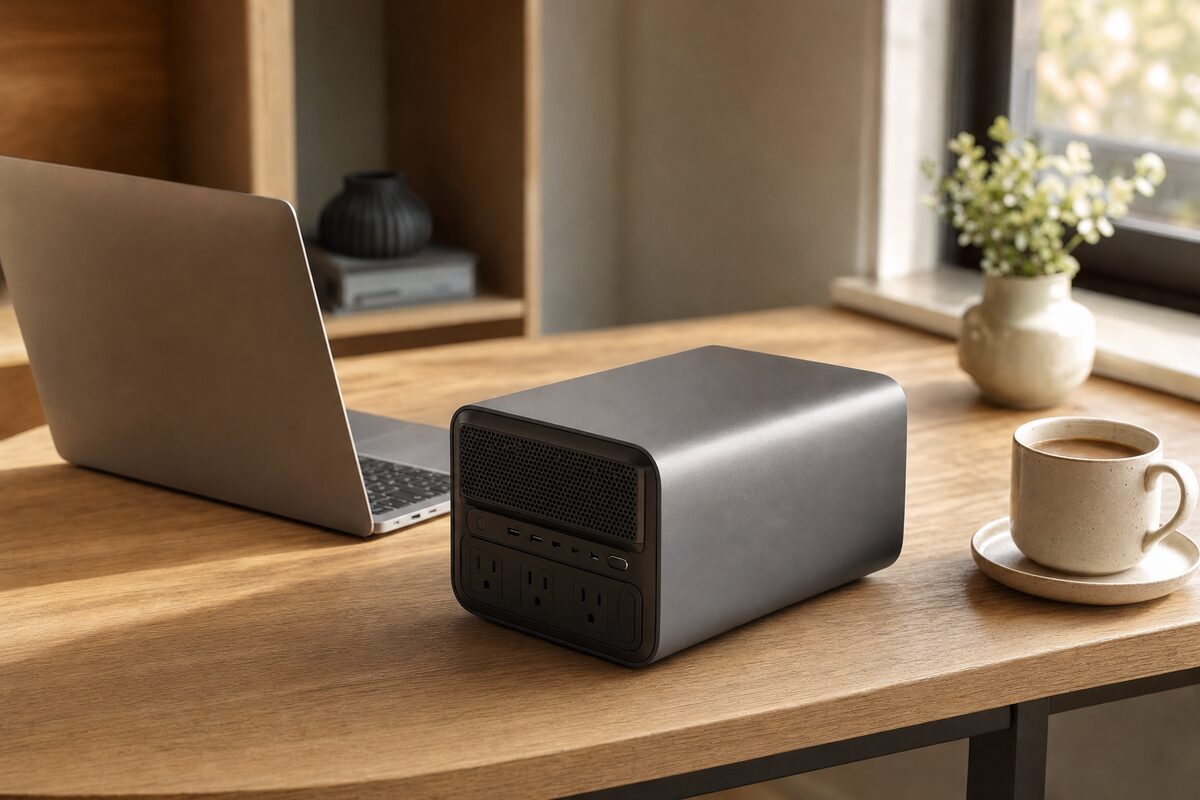
The Anker 548 is a large-capacity portable power bank — 60,000mAh — designed to sit on a desk rather than live in your bag. It's about the size of a chunky hardback book, weighs just over a kilogram, and connects to your laptop, router, or USB devices via USB-C and USB-A ports. There's also a standard AC mains socket on the side, which is where things get genuinely interesting.
Unlike the slim power banks people carry for their phones, this one is built for sustained, desktop use. It charges slowly via mains when plugged in, and passes power straight through to whatever's connected — so your laptop never even knows the building supply has wobbled. When the power cuts, it switches over in milliseconds. You keep working. The router keeps routing. The call keeps going.
Who Is This Actually For?
This isn't for everyone, and it's worth being honest about that. If you live in a city with rock-solid mains power and work mostly in an office, a traditional UPS unit probably makes more sense for your desktop PC setup. But the Anker 548 is a genuinely good fit if you:
- Work from home on a laptop and can't afford to lose work during power blips
- Run a small business where the broadband router dropping mid-video-call is a real problem
- Live somewhere rural where brief outages are just part of life
- Travel occasionally and want a single device that works both at your desk and on the road
- Don't have space or budget for a traditional UPS but still want some protection
It's also genuinely useful for anyone who does their own data recovery work or runs a NAS drive that mustn't be interrupted mid-write — though for a full NAS setup, we'd still recommend a proper UPS.
What's Good About It
The headline feature — that AC mains socket — is rarer than you'd think at this price. Most power banks top out at USB-C, which is fine for phones and modern laptops but useless for anything that needs a standard plug. The Anker 548 handles both.
The 60,000mAh capacity is substantial. In real-world use, that translates to roughly three to four full charges of a typical 15-inch laptop, or several hours of keeping a home router and laptop ticking along simultaneously during an outage. It's not going to replace your mains supply for a full working day, but for the kind of brief-to-medium outages that actually happen in practice, it's more than adequate.
Build quality is solid without being flashy. The LED display shows remaining capacity clearly, the ports are well laid out, and it charges from mains via USB-C PD — so you're not hunting for a proprietary cable. It charges itself reasonably quickly for its size, typically in four to six hours from flat.
It's also genuinely quiet. No fan, no hum — just a small, inoffensive box that sits on your desk doing nothing until it's needed. That's exactly what you want.
What's Not So Good
It's worth being clear about the limitations, because no product is perfect.
- The AC socket output is limited to around 100W. That's fine for a laptop, router or phone — but it won't run a desktop PC, a monitor, or anything with a hefty power draw. If you're on a desktop and need outage protection, a proper UPS is the right tool.
- It's heavy for a portable device. At just over a kilogram, you wouldn't want to carry it in a bag every day. It's designed to live on your desk, and that's really where it belongs.
- The pass-through charging isn't instantaneous like a true UPS. The switchover time is very fast — typically under 20 milliseconds — and most laptops handle that without blinking. But it's not quite the same as a true online UPS that never switches at all.
- It's not cheap. At around £89, it's a meaningful outlay. Though compared to the cost of lost work, corrupted files, or an emergency data recovery job, it starts to look rather reasonable.
Honest Verdict
The Anker 548 is one of those products that solves a real problem without trying to be something it isn't. It won't replace a full UPS for a server rack or a desktop workstation. But for home workers, freelancers and small businesses running on laptops — particularly anyone in an area where the power is occasionally unreliable — it's a quietly brilliant piece of kit.
The customer I mentioned at the start bought one. She's had two brief outages since. Both times, she didn't even notice until she checked her phone and saw the lights had flickered. That's the best review any product can get: the moment you stop worrying about it.
You can find it on Amazon or from Anker directly. If you'd like to see what else we recommend for protecting your data and keeping your setup running smoothly, have a look at our recommended kit page.