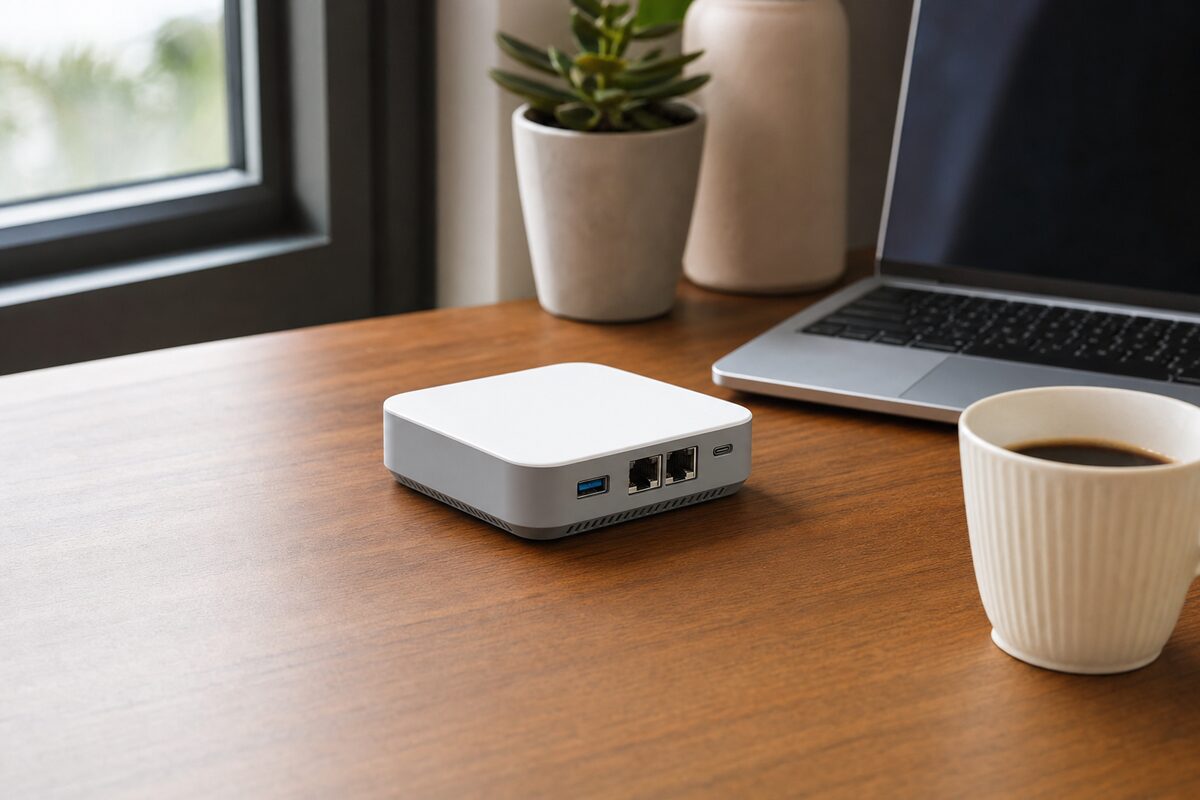
It started with a hotel room in Edinburgh. The Wi-Fi password was printed on a card at reception, the signal barely reached the bed, and by 8pm the connection was so sluggish that a video call was out of the question. Sound familiar? Most of us just shrug and get on with it. But there's a small device — about the size of a thick sandwich — that quietly fixes all of this. And it turns out it's just as useful at home and in the office as it is on the road.
The device is the GL.iNet Beryl AX (model GL-MT3000), and it costs around £85. Here's an honest look at what it actually does, who genuinely needs one, and where it comes up short.
So What Does a Travel Router Actually Do?
A travel router is a compact device that connects to an existing internet source — a hotel's Wi-Fi, a café hotspot, a wired ethernet port, even a phone's mobile hotspot — and then rebroadcasts it as your own private, password-protected Wi-Fi network. Every device you own connects to your network, not the public one directly.
That one shift matters more than it sounds. On a shared public network, other users can potentially see your devices. On your own private mini-network, they can't. It's a meaningful layer of security, not just a gimmick.
But the Beryl AX goes further than older travel routers. It uses Wi-Fi 6 (the current fast standard), has a surprisingly capable processor for its size, and supports a built-in VPN — more on that in a moment.
Who Actually Needs One of These?
More people than you'd think. The Beryl AX is genuinely useful for:
- People who work from hotels or rented spaces regularly — stop fiddling with dodgy public Wi-Fi on every device separately.
- Small business owners with a guest Wi-Fi problem — plug this in and give visitors their own separate network without touching your main router setup.
- Anyone with a home router that can't quite reach the garden office or garage — connect via ethernet from a nearby socket and broadcast a strong local signal.
- Families on holiday — one password, everyone's connected, and you're not handing the villa's router password to a nine-year-old who'll share it everywhere.
- People who use a VPN for privacy or for accessing UK content abroad — set it up once on the router and every device is automatically protected, no apps needed on individual phones or laptops.
If none of those apply to you, you probably don't need one. There's no point buying kit for a problem you don't have.
What's Good — and Genuinely Impressive
The setup is remarkably straightforward. Plug it in, connect your phone or laptop to its default network, open a browser, and a clear web interface walks you through the rest. You don't need to understand networking to get it working in ten minutes.
The Wi-Fi 6 speeds are real. In a hotel where the shared network was crawling at 8 Mbps per device, the Beryl AX pulled a clean 45 Mbps on the wired port and shared that properly across multiple devices. Calls worked. Uploads worked. It felt like a different building.
The VPN support is the standout feature. It works natively with WireGuard and OpenVPN — the two most common VPN protocols — and the interface for setting it up is far simpler than configuring a VPN on each device individually. If you already pay for a VPN service (Mullvad, ProtonVPN, NordVPN and others all export the right config files), you can paste in the details and every connected device is covered automatically. That's a genuinely useful thing.
It's also physically small and light — fits in a jacket pocket, runs off USB-C power, and the included cable and adapter are actually decent quality rather than an afterthought.
Where It Falls Short
Honesty matters here, so let's be direct about the limitations.
- The web interface, while simple, can confuse non-technical users if they stray beyond the basic setup. Terms like "repeater mode," "extender mode," and "WAN" are unavoidable in places.
- Range is modest, as you'd expect from something this small. It'll cover a hotel room and a sitting room comfortably. It won't cover a large house — that's not what it's designed for.
- The VPN setup assumes you already have a VPN subscription. If you don't, you'll need to budget another £4–6/month for a reputable service. Free VPNs are not worth the risk — many of them monetise your data, which defeats the point entirely.
- It's not a replacement for your home router. It's a complement to one — or a solution for specific situations. If your home Wi-Fi is the problem, a better main router is the right fix. We've written about that before.
The Honest Verdict
At £85, the GL.iNet Beryl AX is well-built, well-thought-out, and does exactly what it claims. If you travel with a laptop, work from different locations, run a small business where guests need Wi-Fi, or have been meaning to set up a VPN properly for years — this is one of the tidiest ways to solve all of those at once.
It's not for everyone. If you rarely leave home and your current router works fine, save your money. But if the use cases above sound familiar, this is the sort of purchase that makes you wonder why you didn't get one sooner.
You can find this and other devices we recommend on our recommended kit page. If your home or office Wi-Fi is struggling in general — or you're not sure whether the problem is your router, your cabling, or something else — our team at Advantec's business IT support can have a look and give you a straight answer.