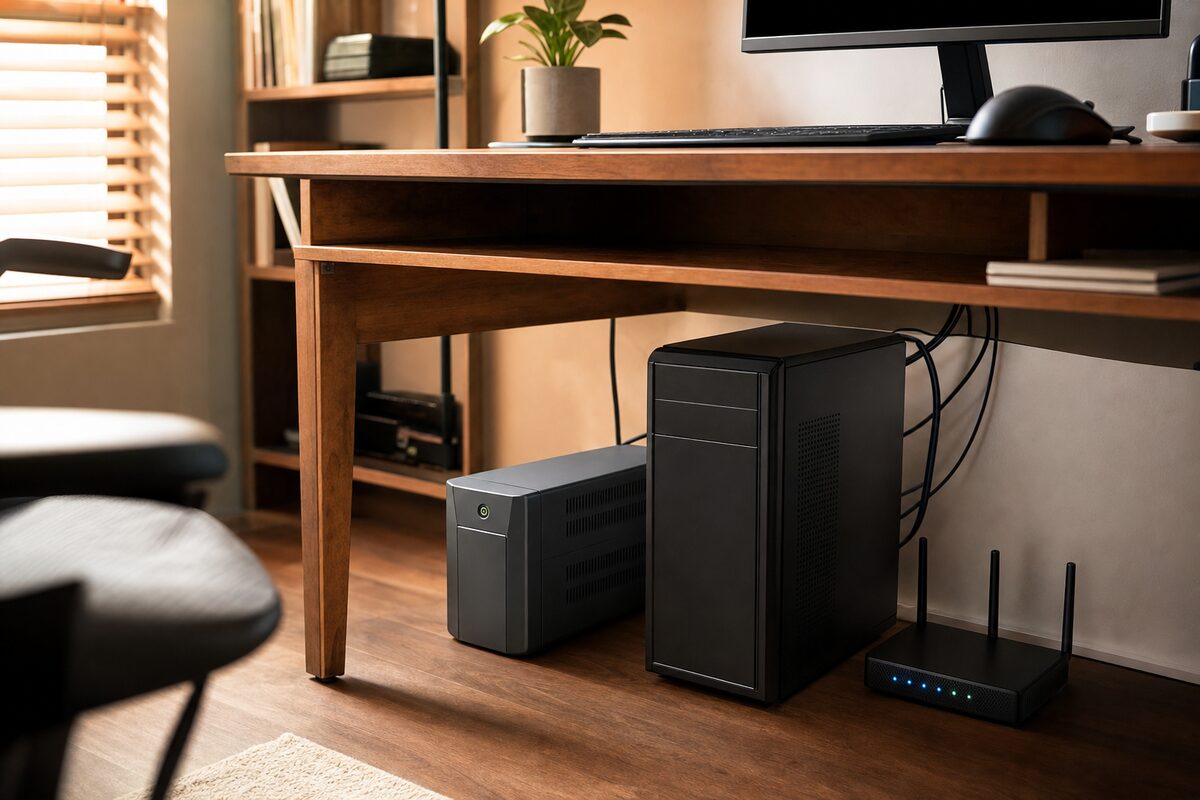
Most people only think about power protection after the lights flicker and they lose 45 minutes of work. Or after a surge quietly fries something expensive. We've seen both happen more times than we'd like — and the frustrating thing is that a small, inexpensive device could have prevented all of it.
This is a review of the APC Back-UPS 600VA (roughly £85 new, sometimes less on refurb). It's not glamorous. It's a chunky grey box that sits under your desk and does absolutely nothing — right up until the moment it saves the day.
What Actually Is a UPS?
UPS stands for Uninterruptible Power Supply. Think of it as a battery backup for your mains sockets. When power cuts out — or even dips or surges — a UPS switches to its internal battery in milliseconds. So fast that your computer, router, or NAS drive doesn't even notice anything happened.
It's not the same as a surge protector, which only protects against spikes. A UPS does that and gives you actual battery runtime — typically 10 to 20 minutes at light load — so you can save your work and shut down properly rather than having the plug yanked out mid-task.
Who Is the APC Back-UPS 600VA Actually For?
This is the first question worth asking, because a lot of people buy the wrong size UPS (too big and expensive, or too small to be useful). The 600VA model sits nicely in the sweet spot for:
- Home office workers running a desktop PC, monitor, and router
- Small businesses protecting a till, a server, or critical network kit
- Anyone with a NAS drive — sudden power loss is one of the quickest ways to corrupt a NAS and lose your backups
- Rural households where brief power dips are a regular occurrence
- People who've already had a bad experience and swore "never again"
It's not designed to run a gaming PC with a big GPU, or to power something through a long outage. For that you'd need a larger unit. But for the typical home or small-business setup, the 600VA is genuinely well-matched.
What's Good About It
The APC 600VA has been around in various iterations for years, and that's actually a mark in its favour. It's been refined, the software is mature, and replacement batteries are widely available — which matters more than people realise.
Here's what we actually like about it:
- Instant switchover. You won't notice a blip. Your screen stays on, your router stays connected, your NAS keeps spinning. That's the whole point, and it delivers.
- Surge protection on all outlets. Even the sockets that aren't battery-backed are surge-protected. Useful for printers and lamps you don't need to run on battery but still want to protect.
- USB connection and free software. Plug it into your PC or Mac via USB and the included PowerChute software will automatically save your work and shut down the machine safely if a power cut outlasts the battery. Set it up once and forget about it.
- Audible alerts. It beeps when it switches to battery, beeps again when battery is low. Simple, but you'd be surprised how many cheaper units don't bother.
- Compact and quiet. It's not small — more like a large lunchbox — but it sits unobtrusively under most desks. The fan only spins under load.
What's Not So Good
Honest reviews include the downsides, so here they are:
- The battery will need replacing eventually. Typically after three to five years. A genuine APC replacement battery costs around £25–£35. Third-party ones are cheaper but vary in quality. It's not a huge deal, but it's worth knowing it's a running cost.
- The beeping. Some people find the alarm piercing. You can silence it via software, but it's not immediately obvious how. It catches people out.
- Runtime is modest. At full load (a desktop PC, monitor, and router all running), expect around 10–12 minutes. That's enough to save your work and shut down properly, but don't expect to keep working through a long outage.
- No LCD display on the base model. You have to use the software to see battery health and estimated runtime. The next model up adds a display, but costs more.
None of these are dealbreakers. They're just worth knowing before you buy.
A Real-World Scenario Worth Thinking About
We fairly regularly see customers whose data recovery situation started with an unexpected power cut. A desktop PC that was mid-write when the power died. A NAS that lost its file table. An external drive that was being used for a backup at the wrong moment. In several of those cases, an £85 UPS would have prevented an expensive and stressful recovery job — or, in the worst cases, data that simply couldn't be recovered at all.
That's not said to frighten anyone. It's just the honest context for why we think this category of device is genuinely underrated and underused by home users and small businesses alike.
Honest Verdict
The APC Back-UPS 600VA is dependable, well-supported, and does exactly what it promises. For the price of a decent meal out, it protects equipment worth many times more and — more importantly — protects the work and data on that equipment, which is often irreplaceable.
It's not exciting. That's the point. The best version of owning this device is one where it sits under your desk for five years, beeps twice during a power cut, and you carry on working without a second thought.
If you'd like to see what we recommend for your specific setup — whether that's a UPS, an external backup drive, or something else entirely — take a look at our recommended kit page for honest picks with no affiliate fluff.