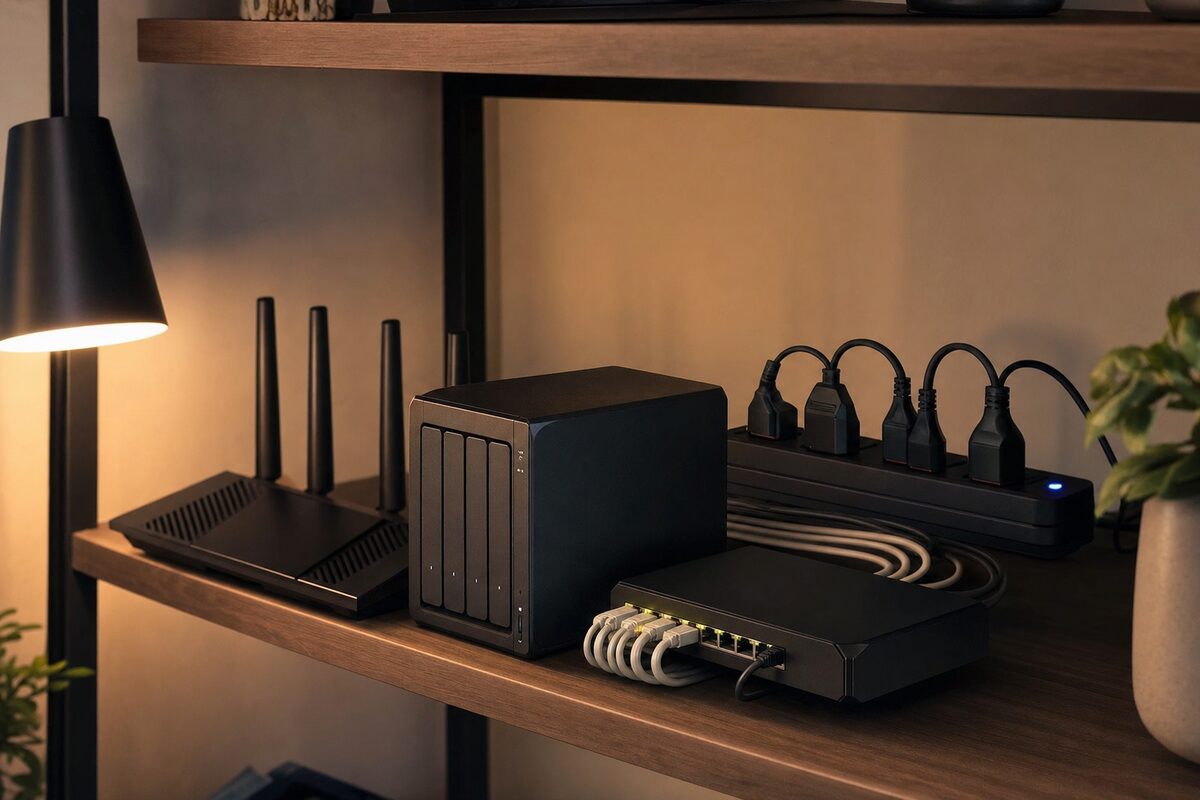
Most people don't think about what's plugged into the wall behind their router. It just sits there, quietly doing its job, and you ignore it — until it doesn't. Then suddenly you've got no internet, a dead modem, and a NAS drive that won't spin up, all because of a power spike that lasted less than a millisecond.
We've seen this exact scenario more times than we'd like. A nearby lightning strike, a neighbour's appliance causing a surge on the line, or even just the power company doing something odd during a brief outage — and suddenly a customer's entire home network is dead. Two or three devices, gone, all at once.
The fix costs £42. It's a surge-protected power strip. Specifically, the Belkin BSV603af2M 6-Outlet Surge Protector with 2m cable — and it's the one we point people towards when they ask what they should have under their desk or behind their router.
Who Is This Actually For?
This isn't aimed at people with a single laptop on the kitchen table. It's for anyone who has a small cluster of always-on devices that would be genuinely painful or expensive to replace:
- A broadband router and modem
- A NAS (network-attached storage) drive used for backups
- A network switch or mesh Wi-Fi base unit
- A desktop PC or home server that runs around the clock
- A small business owner with a dedicated office corner
If you've invested in a proper backup setup — a NAS, an external drive that runs nightly — the last thing you want is a random voltage spike destroying the very devices meant to protect your data. It's a bit like putting a good lock on a door and leaving the window wide open.
What You Actually Get for £42
The Belkin BSV603 gives you six outlets on a 2-metre cable, which is long enough to reach sensibly without looking like an accident waiting to happen. It has a joule rating of 3,940 joules — that's the measure of how much surge energy it can absorb before it stops protecting you. For context, a lot of cheap surge strips you'll find in pound shops or supermarkets offer 200–400 joules. This one is roughly ten times that.
There's also a status indicator light that tells you the surge protection is still active. This matters more than it sounds. Surge protectors don't last forever — each surge they absorb chips away at their capacity. Without that indicator, you'd have no idea whether you were still protected or just using a very expensive extension lead.
The build quality is solid without being flashy. The sockets are well-spaced — you won't find that one large plug blocks two adjacent outlets, which is a minor but genuinely annoying design failure on cheaper strips.
What It Doesn't Do — Be Honest About This
A surge protector is not a UPS (uninterruptible power supply). It will not keep your router running during a power cut. If you need that — and it's worth considering if you work from home — you want something like a small UPS instead, which combines surge protection with a battery backup. We've written about those elsewhere.
It also won't protect against a direct lightning strike to your property. Nothing really will, short of unplugging everything. What it will handle is the far more common scenario: voltage spikes from the mains, surges caused by large appliances switching on and off, and the kind of brief power irregularities that happen more often than most people realise.
And while Belkin does offer a "connected equipment warranty" on this product (they'll cover equipment damaged while properly connected), always read the small print on those claims — getting a payout involves paperwork and proving the cause of failure, which isn't always straightforward.
Real-World Use: Where to Put It
The most useful place for one of these is wherever your networking gear lives. That might be:
- The shelf or cupboard where your router and modem sit
- Your home office desk corner where your desktop, monitor and switch are clustered
- Next to a NAS drive that backs up your household's machines overnight
- Behind a small business reception desk running a PC and card reader
The 2-metre cable gives you decent flexibility for routing it tidily. It's not the sort of thing you notice once it's installed — which is exactly what you want from protective gear.
Honest Verdict
For £42, this is one of the most cost-effective pieces of "insurance" you can buy for your home network and always-on devices. It's not exciting. It won't make your broadband faster or your PC more powerful. But it sits there quietly doing a job that most people don't think about until it's too late.
If you've got a NAS drive, a decent router, or a desktop PC you rely on — and those devices are currently plugged into a basic extension lead with no surge protection — this is worth buying today. The cost of replacing a fried router, modem and NAS simultaneously runs to several hundred pounds at minimum, not counting the potential data recovery work if the NAS drive itself is damaged.
We keep a shortlist of kit we genuinely recommend for everyday home and small-business use — you can find it at our recommended kit page. The Belkin BSV603 is on it for good reason. It's not the only surge protector worth buying, but it hits the right balance of protection, build quality and price without asking you to spend more than you need to.
The bottom line: buy it before you need it, because by the time you need it, it's too late.