It almost always happens the same way. Someone rings us, a little sheepish, explaining that the power flickered for a second — maybe a tripped circuit breaker, maybe a brief cut from the street — and their desktop PC went off. When it came back on, the document they'd been working on for two hours was gone. Or worse, Windows won't start properly because the hard drive was mid-write when the lights went out.
The fix is usually straightforward. But the lost work? That's gone for good. And the frustrating part is that a device costing less than £40 would have prevented all of it.
That device is a UPS — an Uninterruptible Power Supply. It sits between your wall socket and your computer, and it keeps everything running on battery power long enough for you to save your work and shut down safely. It's been around for decades in offices and server rooms. Most home users and small businesses have never heard of it.
What We're Looking At: The APC Back-UPS BE600M2
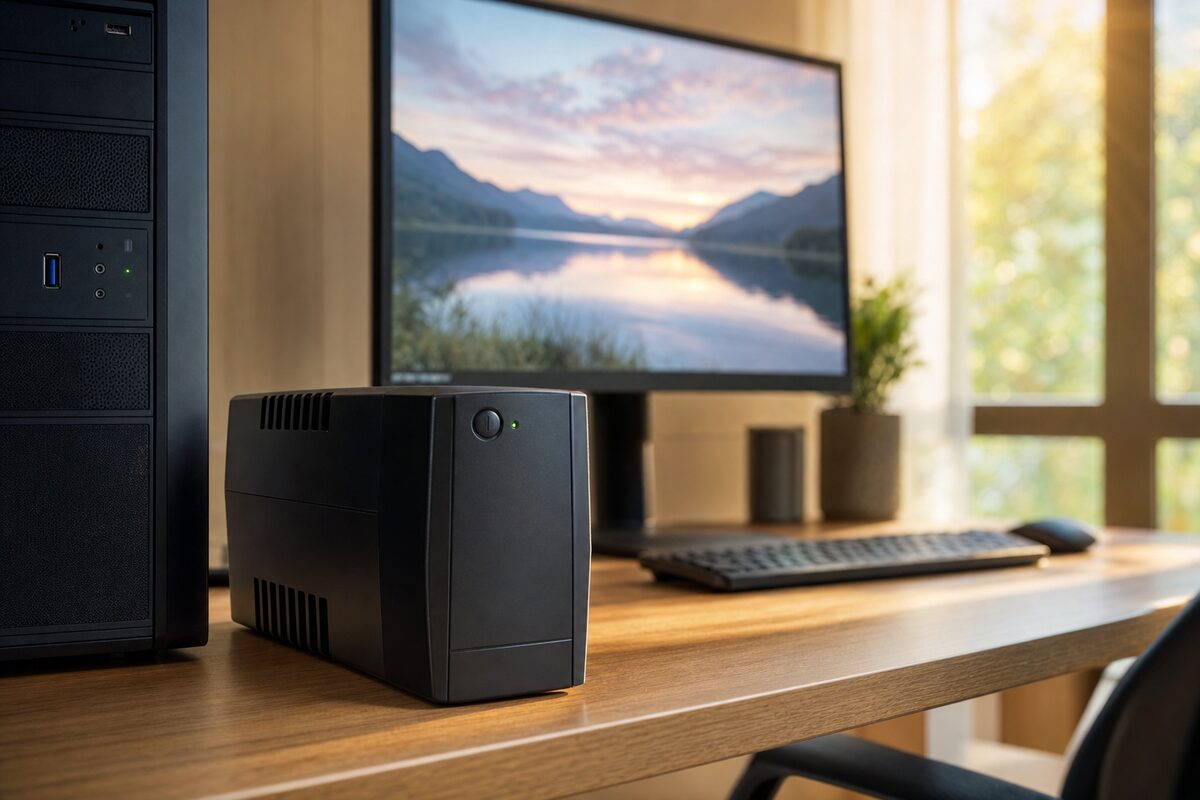
There are plenty of UPS units out there, but the one we most often point people towards for home and small-business use is the APC Back-UPS BE600M2. It's a compact tower unit — roughly the size of a large thermos flask — and it typically sells for between £39 and £55 depending on where you buy it. APC (owned by Schneider Electric) have been making these things for years, and the BE600 range has a solid reputation for reliability without unnecessary complexity.
It provides 600VA / 360W of backup power, has four battery-backed outlets plus two surge-only outlets, and includes a USB port for charging a phone or tablet. There's also a USB data port so your PC can detect a power cut automatically and begin a graceful shutdown if you're not at the desk.
Who Is This Actually For?
This is not a device for data centres or heavy-duty servers. It's for:
- Home users with a desktop PC — especially if you do anything involving photos, documents, spreadsheets, or creative work that takes time to recreate.
- Small business owners who run a PC or Mac desktop in an office or workshop, where a sudden shutdown could corrupt files or accountancy data.
- Anyone who works from home and can't afford to be knocked offline or lose an open document mid-afternoon.
- People in rural areas — including much of the Weald and Romney Marsh — where power can be less consistent than in towns.
It is not designed to keep your computer running for hours. A typical desktop PC and monitor will get around 10 to 20 minutes of battery time from this unit. That's not meant to be a working session — it's enough time to save everything, send an email if you need to, and shut down properly.
What's Good About It
The BE600M2 is genuinely well-made for the price. Setup is simple: plug it in, charge it for a few hours, then plug your PC and monitor into the battery-backed sockets. That's it. There's no complicated configuration unless you want the automatic shutdown software, which installs easily and works reliably on both Windows and Mac.
The surge protection on all six outlets is worth having in its own right. Lightning nearby, a neighbour switching on heavy machinery, the grid doing something odd — all of those can send a voltage spike down your mains wiring. A good surge protector absorbs that before it reaches your equipment. The BE600M2 handles this quietly in the background.
It also has an audible alarm when it switches to battery, which sounds obvious but is genuinely useful — you hear it from another room and know to come and save your work.
The replacement battery (when it eventually needs one, usually after three to five years) is a standard sealed lead-acid cell and costs around £15–20. You slot it in yourself. No need to replace the whole unit.
What's Not So Good
It's worth being honest about the limitations:
- Runtime is short. If you're running a large tower PC with a power-hungry processor and a big monitor, you might get closer to 8–10 minutes than 20. It's a safety net, not a generator.
- It won't run a laser printer. Laser printers draw far too much power during printing. Plug a laser printer into a UPS and you'll almost certainly trip the overload protection. Inkjet printers are usually fine.
- It's heavy for its size — the lead-acid battery inside accounts for most of the weight. That's not a problem once it's in place, but worth knowing.
- No LCD display at this price point. You get LED indicators rather than a screen showing precise battery percentage. For most home users that's absolutely fine.
A Practical Note on Laptops
If you use a laptop as your main computer, you already have a built-in battery — so a UPS is less critical for keeping you running during a brief power cut. Where it still earns its keep is protecting your router and any external drives or docking stations you have plugged in. An unexpected shutdown can be just as harmful to an external drive mid-write as it is to a desktop hard drive.
If you're running a desktop — whether Windows or Mac — and you don't have a UPS, this is genuinely the single most cost-effective piece of protection you can add to your setup. It costs less than a good lunch out, it installs in five minutes, and it sits there doing nothing until the one day it's needed — at which point it earns back its cost ten times over.
Honest Verdict
The APC Back-UPS BE600M2 is not glamorous. It won't speed up your computer, improve your screen, or make anything visibly better on an ordinary day. What it does is stop a one-second power blip from becoming a very bad afternoon. For desktop PC users, home office workers, and small businesses running any kind of important data, we think it's close to essential.
You can find it on Amazon, Scan, or Ebuyer. If you'd like a recommendation for your specific setup — particularly if you have a more powerful machine that might need a higher-rated unit — have a look at our recommended kit page or just give us a ring. We're happy to point you in the right direction without any obligation.