It was a Tuesday afternoon. A customer brought in a laptop with a corrupted Windows installation — not because of a virus, not because of a failing drive, but because a brief power blip had hit the machine mid-update. The kind of power interruption that lasts less than a second. The kind you barely notice. The kind that, it turns out, can cost you an afternoon of recovery work and, in this case, a shop visit.
The fix was straightforward. But it prompted a conversation we have surprisingly often: "Is there anything I can plug in that just… stops that happening?" Yes. It's called a UPS — an Uninterruptible Power Supply. And the one we keep coming back to recommending for home users and small offices is the Anker Solix C300.
What Even Is a UPS?
A UPS sits between your devices and the wall socket. Inside it is a battery. When the power cuts out — even for a split second — the battery kicks in seamlessly. Your computer never knows anything happened. You carry on working, finish saving your document, and shut down properly when you're ready.
They've been standard kit in server rooms for decades. The reason they're still uncommon in home offices is mostly that people don't know they exist — or assume they're expensive and complicated. The Anker Solix C300 is neither.
Who Is This Actually For?
Not everyone needs a UPS. If you're on a laptop and it's plugged in, you're already protected — the battery is your backup. But if any of the following sound familiar, a UPS is worth serious consideration:
- You have a desktop PC, and losing power mid-task has cost you work before
- You run a NAS (network-attached storage) drive at home — these are particularly vulnerable to sudden power loss, which can corrupt the entire array
- Your router and broadband hub are in an area where power occasionally flickers
- You work from home and a power cut means a lost video call or a lost hour of unsaved work
- You're in a rural area — and if you're reading this in Kent, you'll know exactly what late-autumn storms can do to your power supply
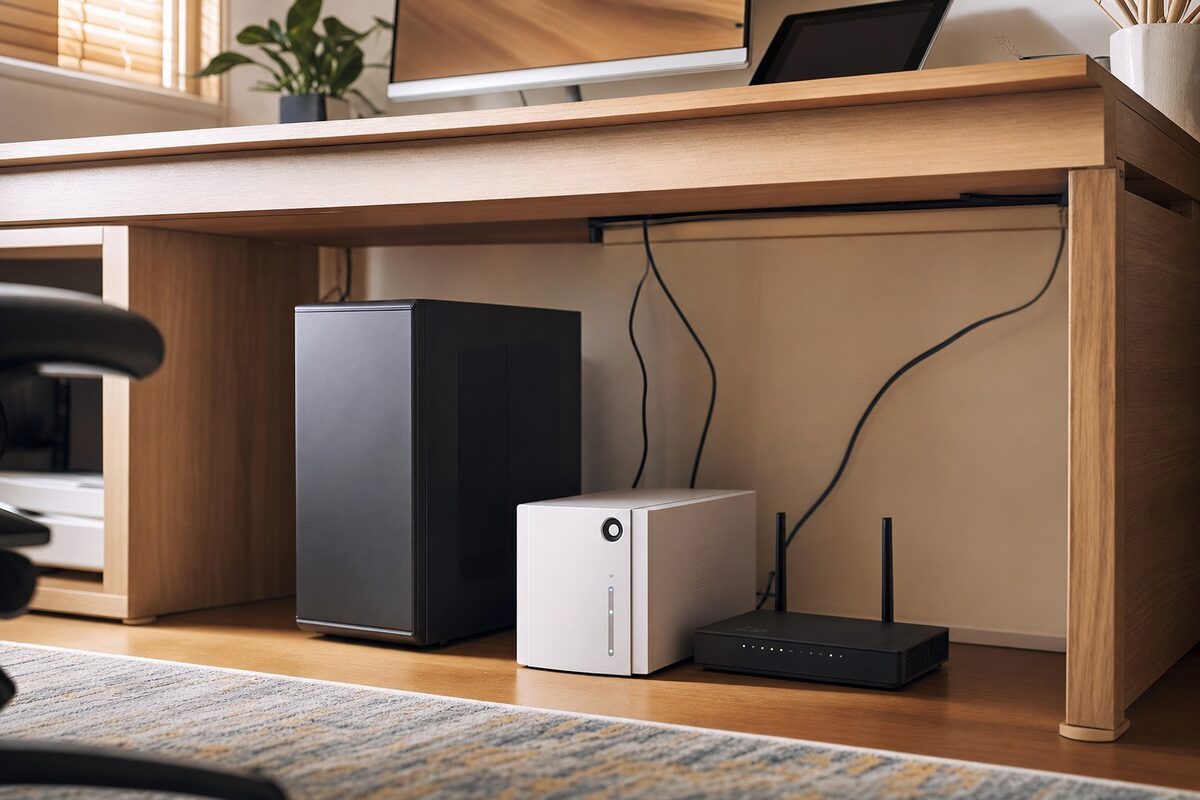
The C300 is compact enough to sit under a desk or beside a router without being obtrusive. It's not designed to run your whole office for an hour — but that's not what most people need.
What's Good About It
The headline figure is 300W of continuous output with a 288Wh battery. For a typical desktop PC (not a gaming rig), a monitor, and a router, you'd realistically get somewhere between 20 and 40 minutes of runtime. That's enough to save your work, do a proper shutdown, and make a cup of tea while you wait for the lights to come back on.
What sets the C300 apart from older-style UPS units — the chunky black boxes that look like a small car battery — is the form factor. It's genuinely compact, relatively light, and has a clear display showing current load, battery level, and estimated runtime. No guessing.
It also charges quickly. Some older UPS units would take eight or ten hours to recover after a discharge. The C300 handles a full recharge in a few hours, which matters if you've had a rough day for power and need it ready again by morning.
The outlets include both standard UK plugs (the battery-backed ones) and USB-A and USB-C ports, which is handy for keeping phones or tablets topped up during an outage too. And unlike many budget UPS options, the switchover to battery is essentially instant — genuine zero-interruption, not a slight flicker that still manages to crash older hardware.
What's Not So Good
Honesty matters here. The C300 is not a full power station. If you need to run a high-end desktop with a dedicated graphics card, a large monitor and external drives, you'll chew through that battery much faster — possibly in under ten minutes. For anything power-hungry, you'd want to look at the larger Solix models or a more traditional rack-style UPS.
There's also no automatic graceful-shutdown software included in the box. Some UPS units come with software that will instruct your PC to save and shut down automatically if the battery drops below a set level. The C300 doesn't do this out of the box — you get the runtime, but the shutdown decision is yours. For most home users that's fine; for a server or a machine that might be left unattended, it's worth knowing.
And the price — currently around £89 to £110 depending on retailer and any offers — is fair but not trivial. It's a considered purchase, not an impulse buy.
Honest Verdict
If you have a desktop PC, a NAS, or a home-office setup that you rely on, the Anker Solix C300 is one of the most sensible single purchases you can make. It's quiet, it's compact, it works without any setup fuss, and it protects against the kind of mundane power problem that causes data loss and unexpected repair bills far more often than viruses or hardware failure.
It's not for everyone. If you're just browsing the web on a laptop, you don't need it. But for anyone running a home business, keeping important files on a desktop, or relying on a NAS for backups, it earns its place under the desk very quickly indeed.
If you'd like to see what else we tend to recommend for home and small-business setups, take a look at our recommended kit page — it's kept up to date and genuinely reflects what we'd buy ourselves.
Practical takeaway: Before you buy, add up the wattage of everything you want to protect (it's usually printed on the back of each device or in its manual). Keep the total well under the C300's 300W limit for the best runtime — and prioritise battery-backed outlets for your PC and router, not your desk lamp.