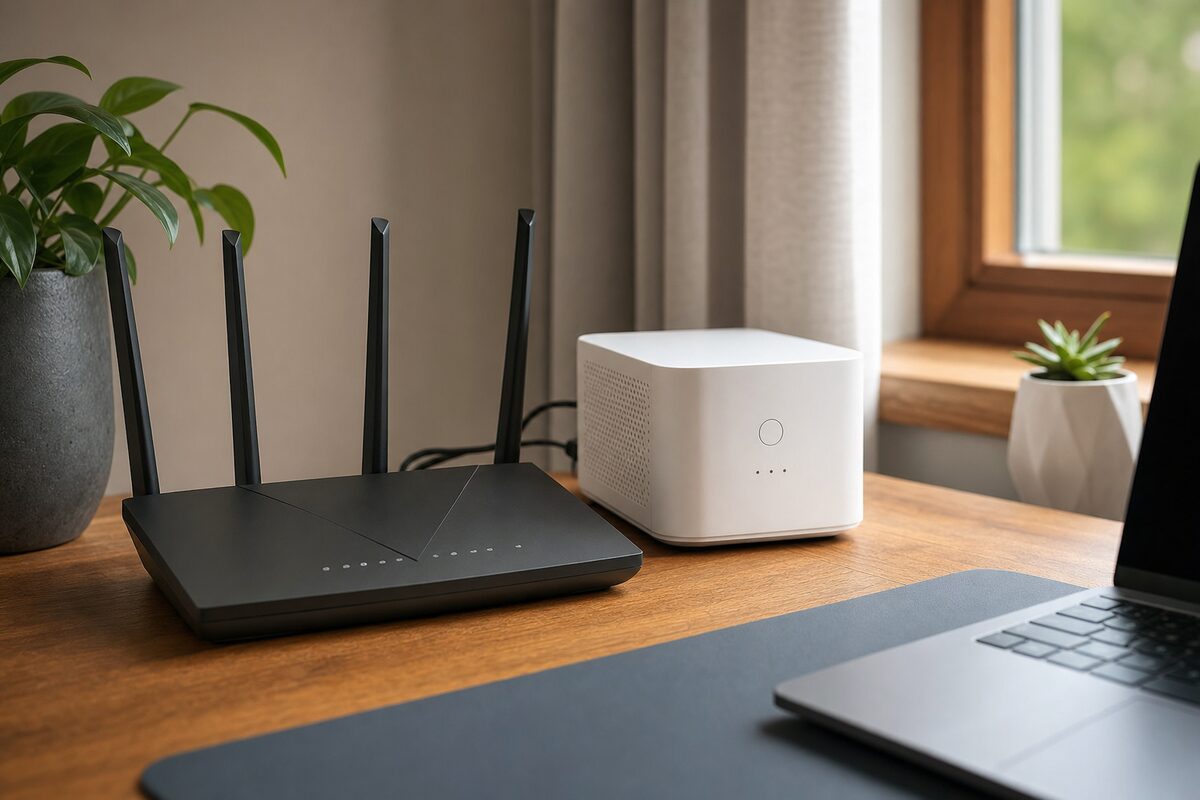
It always happens at the worst moment. You're halfway through a video call, or your broadband router has finally got a stable connection after days of faffing with settings, and then — click — the power goes off. The router reboots, your call drops, and by the time everything comes back up you've missed the important bit of the meeting. Sound familiar?
The fix is surprisingly small, surprisingly affordable, and genuinely underrated: a mini UPS (Uninterruptible Power Supply) designed specifically for routers and small network gear. Not the big heavy cabinet-style UPS you'd find in a server room — just a compact little box, roughly the size of a chunky paperback, that sits quietly behind your router and keeps it running through a power cut.
We've been recommending these to home users and small businesses for a couple of years now, so here's an honest look at what they are, who they're for, and which one we think is worth buying.
What Is a Mini UPS and How Does It Work?
A UPS is essentially a box with a rechargeable battery inside. It sits between the mains socket and your device. Under normal conditions it just passes power through and keeps its internal battery topped up. The moment the mains power disappears — whether it's a full cut or even just a brief flicker — it switches to battery power instantly, fast enough that your router never notices. No reboot, no dropped connections.
Full-size UPS units are designed to run servers and desktop PCs for 10–20 minutes during a power cut, which is why they're bulky and expensive. A mini UPS only needs to run a router and perhaps a small network switch — both of which draw very little power — so its battery can be tiny, and the whole thing stays compact and cheap.
Who Actually Needs One?
Honestly, more people than you'd think. You'd benefit from a mini UPS if any of the following apply to you:
- You work from home — dropped VoIP calls and lost video meetings cost real money and real embarrassment.
- You use a VoIP phone system — without power, a router-dependent phone line goes completely dead.
- You live in a rural area — brief power cuts and flickers are far more common than urban areas, and each reboot can take your router 2–3 minutes to reconnect fully.
- You run a small business from home or a small office — a £30 device preventing even one lost hour of productivity is an obvious win.
- You have smart home kit — cameras, doorbells, heating controls and the like all lose their cloud connection and sometimes their settings when the router drops.
If your internet goes down once a year and you mostly stream TV, you probably don't need one. But if any of the above ring a bell, read on.
The One We Recommend: Vonets Mini DC UPS (or the Budget-Friendly Uomig)
There are a few mini UPS units worth considering, but the ones that consistently get good real-world results for home and small office use are the Vonets Mini UPS range and the very similar Uomig Mini UPS. Both are available for £25–£45 depending on the battery capacity you choose.
What they do well:
- Multiple DC output voltages (typically 5V, 9V, and 12V), so they work with the vast majority of home routers and small switches straight out of the box
- Pass-through charging — the battery tops up while powering your router, so you're never choosing between one and the other
- Genuinely compact — about the size of a fat wallet; easy to tuck behind the router
- Simple LED indicators so you can see battery state at a glance
- No software, no app, no setup — you plug it in and forget about it
- Typical runtime of 2–4 hours on a single router (longer if you get the higher-capacity model), which is more than enough for most power cuts
What's not so great:
- The supplied DC cables and tips can be a bit fiddly — check your router's power input voltage before buying and make sure the right tip is included
- The battery will degrade over a few years, as all lithium batteries do — expect to replace the unit rather than the battery, as they're not user-serviceable
- They won't run a desktop PC or a NAS drive — they're only for low-power network gear
- The branding and packaging look a little generic, which puts some people off, but the hardware itself is solid
What to Check Before You Buy
Before ordering, just confirm two things about your router (both are usually on a label on the bottom of the router itself):
- The input voltage — most home routers run on 12V DC, but some use 9V or even 5V. Make sure the mini UPS you choose supports it.
- The barrel connector size — the most common size is 5.5mm outer / 2.1mm inner, and most mini UPS kits include this, but double-check.
If you're unsure, bring the router's power adapter into us and we can check in seconds.
Honest Verdict
For anyone who works from home, runs any kind of VoIP setup, or simply lives somewhere that gets the occasional power flicker, a mini UPS is one of those rare purchases that genuinely earns its keep. It does exactly one job, it does it silently and invisibly, and once it's plugged in you'll probably never think about it again — until the power goes out and your router stays up while your neighbour's doesn't.
At £25–£45, it's not an impulse buy for everyone, but it is remarkably good value for what it prevents. We'd rate it as one of the most practical small tech purchases a home office worker can make.
You can find our wider list of recommended kit — things we've actually tested and stand behind — over on our recommended products page. And if you're having recurring issues with your broadband setup, networking gremlins, or anything related to your home or business IT, we're always happy to take a look.